A data center alert at 2 a.m., or the entire company unable to access Yonyou or Kingdee systems on Monday morning, is often the first moment an enterprise realizes its servers have been hit by ransomware.
In the past, many enterprises focused antivirus efforts on employees' office computers, but under the 2026 security landscape, attackers have completely shifted their sights to core servers. According to the "August 2026 Ransomware Trend Analysis" and "September 2026 Ransomware Trend Analysis" recently released by 360 Digital Security Group, in the statistics of infected system types, servers have far surpassed desktop PCs; Windows Server 2012, Windows Server 2016, Windows Server 2008, and Linux web servers exposed to the public internet (including some Xinchuang operating systems) are all among the high-frequency targets.
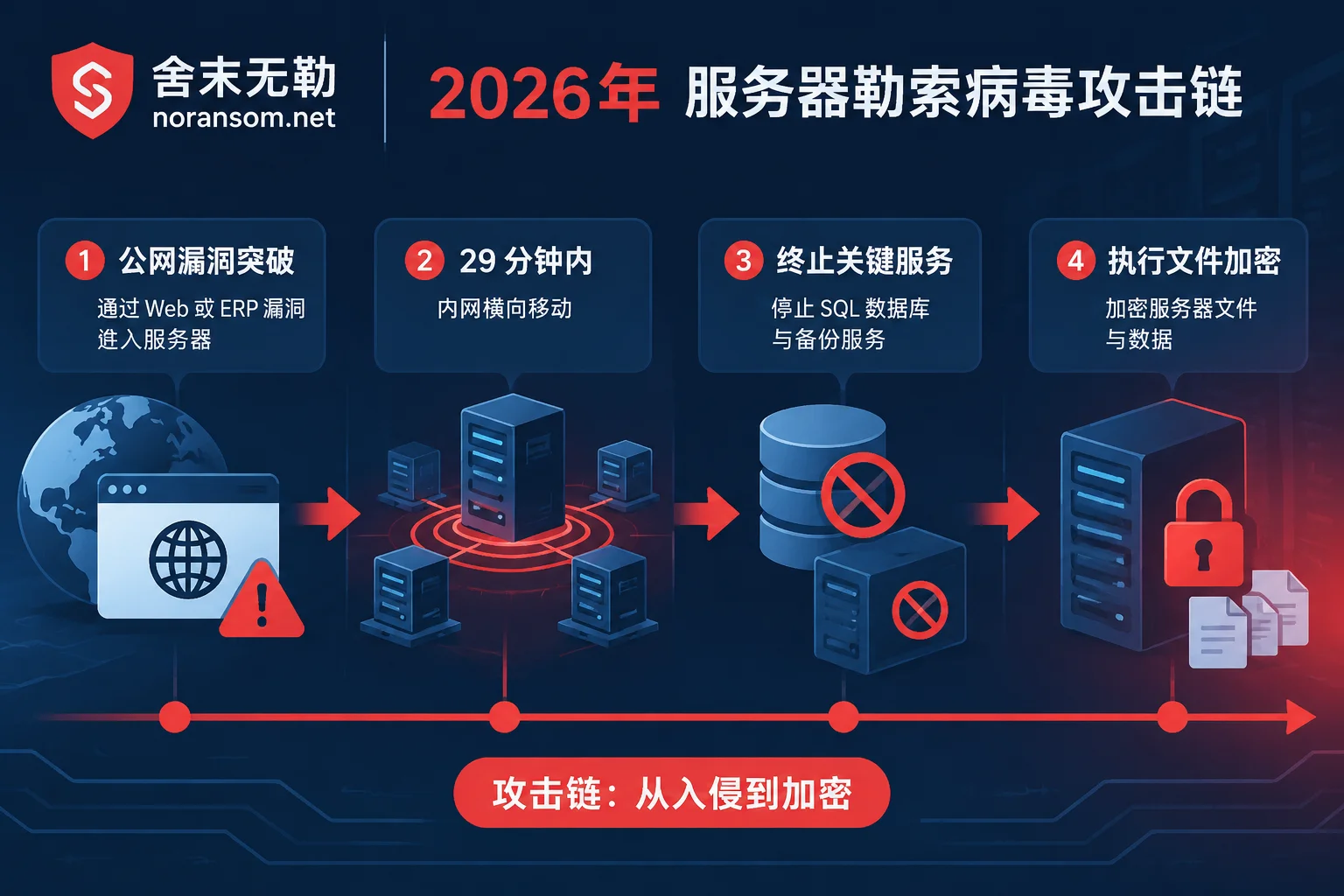
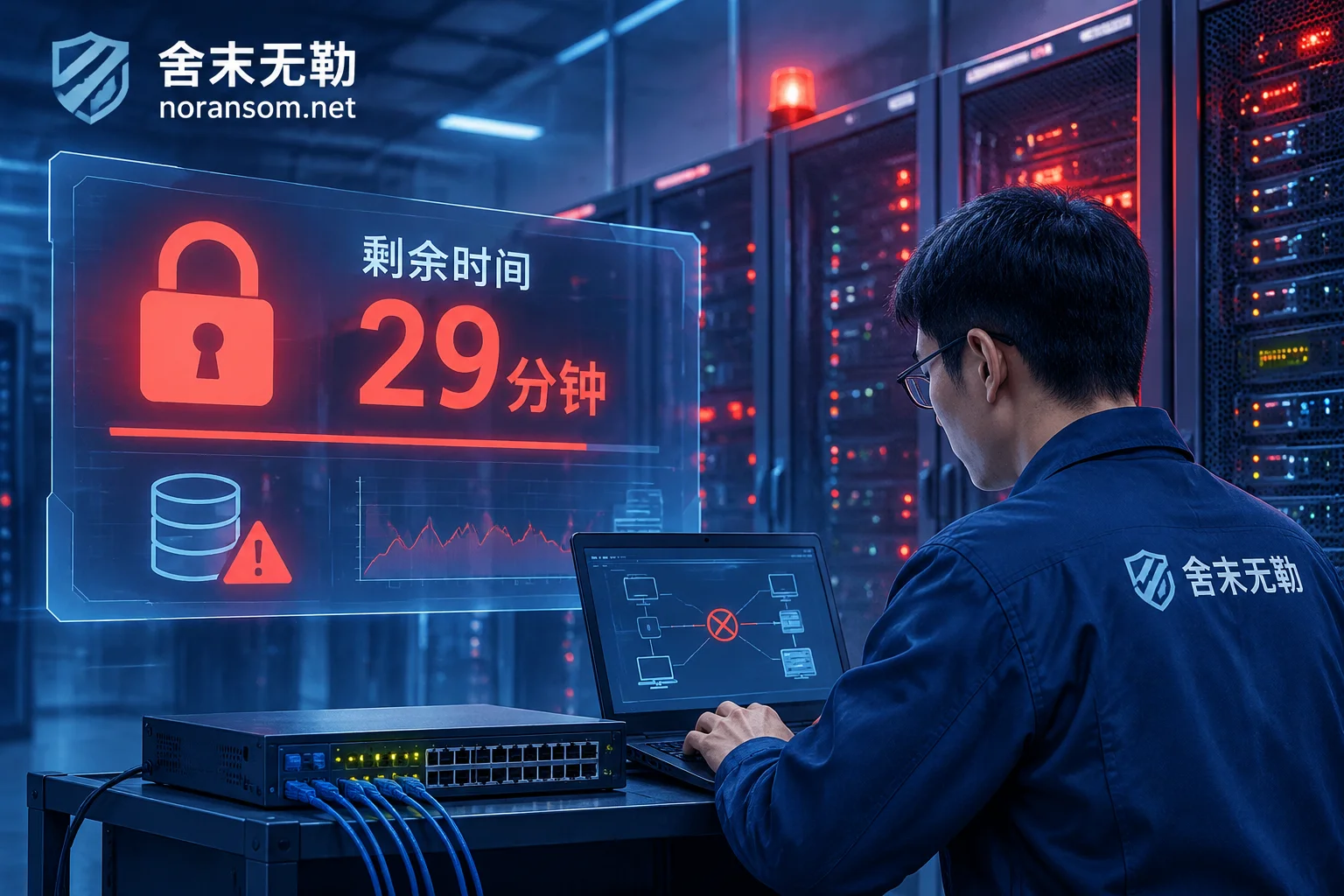
What is more severe is the reaction window left for IT operations staff. Data disclosed in authoritative 2026 threat reports (such as CrowdStrike's "Global Threat Report 2026" and Verizon's "DBIR 2026") show that vulnerability exploitation has become the top initial access vector at 31%, and the average breakthrough time for attackers from gaining a foothold on the first machine to beginning lateral movement to other servers has been compressed from 48 minutes to 29 minutes.
When attackers can map the internal network topology, stop database services, delete volume shadow copies, and complete encryption within half an hour, the traditional "reinstall the system and find local backups" approach often fails once an enterprise discovers its servers are compromised. Facing paralyzed business operations, how should business leaders and IT operations stabilize the situation and rescue core account sets and business data?
I. Why Have Servers Become the "Number One Target" for Ransomware Attacks in 2026?
From recent security bulletins and frontline emergency statistics, today's ransomware attacks against servers are no longer indiscriminate "wide net" campaigns but highly automated precision strikes. The following characteristics explain why enterprise defenses are breached in a short time (for deeper reasons behind defense failures, see our previous analysis: Why Do Core Account Sets and Servers Still Fall Overnight Despite Antivirus and Backups?):
- Exploiting high-risk vulnerabilities to strike directly at the business foundation: In the September 2026 domestic victim device statistics, Weaxor ransomware (common extensions such as
.rox,.weax,.wxx) tops the list with over 70% share. Its core tactic is to massively exploit ERP software and web application vulnerabilities to directly invade business servers, even combining BYOVD (Bring Your Own Vulnerable Driver) techniques to bypass endpoint protection. - Cross-platform and stealthy disguise: Take the 2026 new family Sorry ransomware (and its September-evolved
.thsvariant) reported by the National Computer Virus Emergency Response Center as an example. After attackers exploit panel authorization bypass vulnerabilities (such as CVE-2026-41940) or old OA/ERP vulnerabilities to gain privileges, they deploy a payload written in Go and disguise the process as a normalsshdservice, making it extremely difficult for IT operations staff to detect during routine troubleshooting (see details in Sorry Ransomware Rescue Guide from .sorry to .ths Variants). - "Clear the field first, then encrypt, and take data along the way": Whether it is Weaxor, Mallox, LockBit on Windows platforms, or new variants on Linux platforms, the standard action after landing on a server is to first forcibly terminate databases (SQL Server, MySQL, Oracle), security protection, and backup services. Moreover, ransomware is involved in nearly half of confirmed data breach incidents—before pressing the encryption key, hackers often have already stolen sensitive configurations and business documents from servers in bulk, attempting to force enterprises into submission with "business shutdown + data exposure".
II. The "Golden Damage Control Period" After a Server Ransomware Attack: Do These Three Things Right First
When you discover server file extensions have been tampered with and business systems report errors and cannot connect, blind operations in panic are often more destructive than the virus itself (further reading: Don't Make These Five Mistakes After a Server Ransomware Attack). Before contacting professional institutions, internal IT operations should immediately execute the following three steps:
1. Physically disconnect the network, but never blindly power off or restart
Because hackers move laterally extremely fast, and some viruses (such as the Sorry family) automatically scan internal network ports 22, 2222, 3389, 445, etc. for weak-password lateral brute-force attacks, the first priority is to unplug the network cable of the infected server, or block its internal and external communications on the core switch or cloud security group to cut off the spread path.
At the same time, please note: try not to directly pull the power plug or restart the server. On one hand, memory (RAM) may retain undestroyed encryption traces, attacker connection sessions, or fileless attack payloads, which are key for subsequent forensics and analysis; on the other hand, some database files or virtual disks not fully written to disk may trigger disk self-checks or log overwrites after a forced restart, completely destroying the conditions for low-level data rescue.
2. Protect the primary scene, prohibit blindly running third-party "universal decryptors"
Photograph or fully copy the ransom note text (such as hello.txt, README, etc.), record the complete tampered file extension, and protect system logs and remaining suspicious samples.
Never forcibly attach encrypted .mdf database files to a new instance, and do not casually download "cracking tools" of unknown origin from the internet to trial-and-error directly on production disks—as the National Emergency Center has emphasized multiple times in warnings, so-called "low-price decryption agents" and unknown communication tools circulating online can easily bring secondary Trojan infections or directly damage original data blocks.
3. Identify the family, treat ransom demands rationally
Different encryption extensions correspond to completely different algorithm mechanisms and recovery possibilities. IT operations staff can first use the free online tool provided by SheMoWuLe—Ransomware Identification (or consult the Ransomware Extension Master List), enter the encrypted file extension or ransom note filename, and quickly identify the Ransomware Database family and current basic recoverability.
It must be clear: do not easily pay the ransom to hackers. The black market has no credibility; cases are common where no valid key is obtained after payment, keys fail to decrypt large files, or even secondary extortion occurs because the victim is marked as a "high-quality paying target".
III. Refuse to "Gamble on Luck": How Is Core Server Data Scientifically Rescued?
After a server is compromised, many enterprises fall into a dilemma: official bulletins say "no reliable recovery method without private key"—does that mean the data is completely lost?
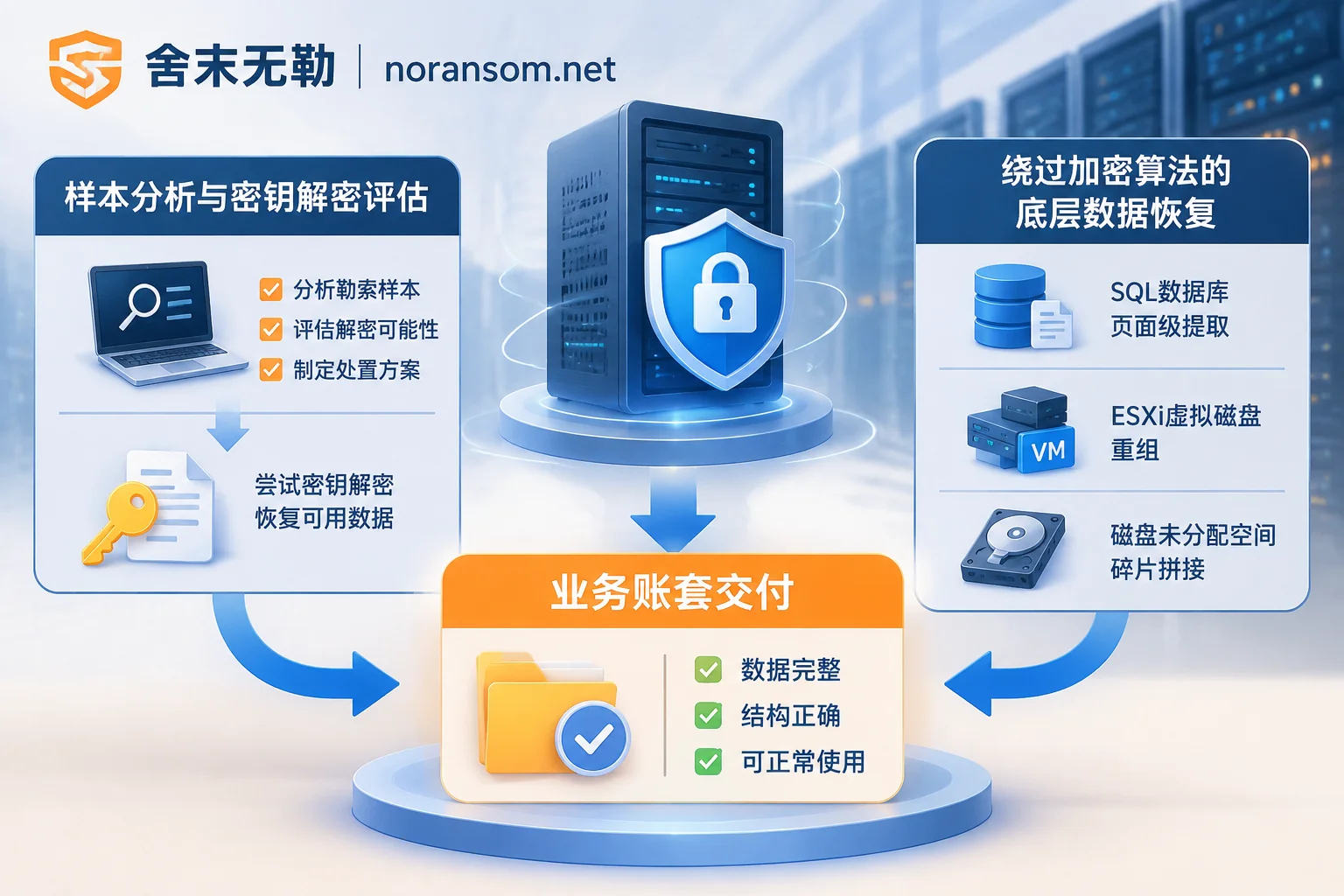
In fact, "whether a universal free decryptor exists" and "whether specific business data can be rescued" are two different things. For enterprise server environments, SheMoWuLe (noransom.net) under Zhengzhou SheMo Information Technology Co., Ltd. adheres to the principle of "no ransom payment, no negotiation with attackers on behalf of clients" and adopts an engineering path of "first identify the family, assess the recoverable scope, then provide a plan and quote", helping enterprises recover core assets through two core technical routes:
Route 1: Ransomware Decryption and In-depth Recoverability Assessment
For families with known algorithm flaws, key management vulnerabilities, or specific variant characteristics, the team first conducts reverse analysis on infected samples and encrypted file headers and performs Ransomware Decryption assessment. Before formally starting, a clear recoverability assessment report is issued to the enterprise (specifying recoverable scope, optional technical paths, expected results, and potential risks), allowing business owners to make decisions with full confidence.
Route 2: Low-level Data Recovery (When Direct Decryption Is Not Feasible)
Facing new variants using strong AES+RSA double-layer encryption without public keys, brute-forcing cryptographic algorithms is often unrealistic. At this point, SheMoWuLe's Data Recovery service bypasses the cryptographic dead end and seeks breakthroughs from the low-level structures of the operating system, file system, and storage:
- Database file-level repair: To pursue "second-level encryption" speed, ransomware often adopts header encryption, interval sampling encryption, or fixed-ratio overwrite strategies when processing database files of tens to hundreds of GB (such as
.mdf,.ndf,.ibd,.dbf). Engineers can parse the underlying data page structure, strip damaged blocks, and directly extract and reassemble high-value table data and business records. - Extraction of unencrypted remnants and disk fragments: Deep scan and reassemble historical data blocks that were deleted or not yet overwritten in unallocated disk space, temporary cache areas, and log fragments.
- Repair of damaged backups and snapshots: Even if local backup files or volume shadow copies are damaged by the virus or have tampered extensions, there is still room to repair historical usable versions through low-level sector-level scanning and image stitching. All recovered data is delivered transparently with completeness marked by system and time point.
Targeted Solutions for Four High-Frequency Server Damage Scenarios
Servers with different business architectures have completely different rescue logic. SheMoWuLe provides Scenario-based Solutions for specific areas:
- SQL Server Database Encrypted: Never directly rebuild logs or forcibly attach. Through low-level page-level parsing and transaction log correlation repair, core business tables are restored to the maximum extent.
- Yonyou / Kingdee / Guanjiapo / SAP and Other ERP Encrypted: For financial and inventory systems such as Yonyou U8/NC/Chanjet T+, Kingdee K/3/KIS/Cloud Cosmic, Guanjiapo, and Suda, not only the underlying database is repaired, but also business-level verification is combined with the account set structure to ensure that the restored account set can log in, query, and perform accounting normally.
- ESXi / Hyper-V Virtual Machines Encrypted: Whether the host-level
.vmdk/.vhdxvirtual disk files are locked or the virtual machine's internal system is infected, internal databases and business files can be extracted through flat volume parsing and virtual disk structure reassembly. - Synology NAS Encrypted and Backups Deleted or Damaged: For compromised storage pools and shared directories, combine RAID structure analysis and snapshot remnants to rescue key archives; if Domain Controller Compromised and Entire Network Encrypted occurs, formulate a phased damage control and reconstruction plan based on spread risk and business priority.
IV. Why Is Data Recovery Alone Not Enough? Closed-loop Emergency Response Prevents "Secondary Encryption"
In frontline handling, the most heartbreaking scenario is when an enterprise spends days painstakingly repairing its database and bringing it online, only to have the server encrypted again with the same ransomware extension in less than 48 hours (see details: Recovering Data Is Only the First Step—Don't Rush to Go Online Before Cleaning These Four Types of Backdoors).
The reason is simple: attackers who can complete lateral movement in 29 minutes must have left hidden persistent backdoors in the internal network (such as disguised system services, scheduled tasks, webshells, hidden admin accounts, or even Silver Fox Trojan remote control sessions潜伏 on office endpoints). If you only repair data and do not clean backdoors, it is tantamount to repairing the environment for hackers and waiting for the next harvest.
To this end, SheMoWuLe incorporates server rescue into a complete closed-loop system:
- Security Emergency Response: 7×24 hour incident reception, supporting remote and on-site handling. Strictly follows the iron rule of "damage control first, then forensics, then recovery", controlling the scope of impact at the first opportunity, comprehensively investigating and removing internal network persistence, preserving key evidence, and completely eliminating the vicious cycle of "being re-encrypted while recovering".
- Attack Tracing and Forensics: Based on remaining server logs, disk images, and memory evidence, accurately reconstruct exactly which unpatched ERP vulnerability, which weak-password port, or which jump host controlled by Silver Fox the hacker entered through, clarify the attack timeline, determine whether sensitive data has been substantially leaked, and issue professional forensic reports usable for police reporting and enterprise compliance audits.
- Security Hardening and Protection: Before business verification and go-live, assist IT operations teams in significantly reducing external exposure, remediating weak passwords and remote access policies, assisting in investigating high-risk vulnerabilities, converging domain and server permissions, and planning and rebuilding an isolated backup system that cannot be easily deleted by ransomware.
V. Standardized Handling Process: Review the Assessment Conclusion First, Then Decide on Recovery
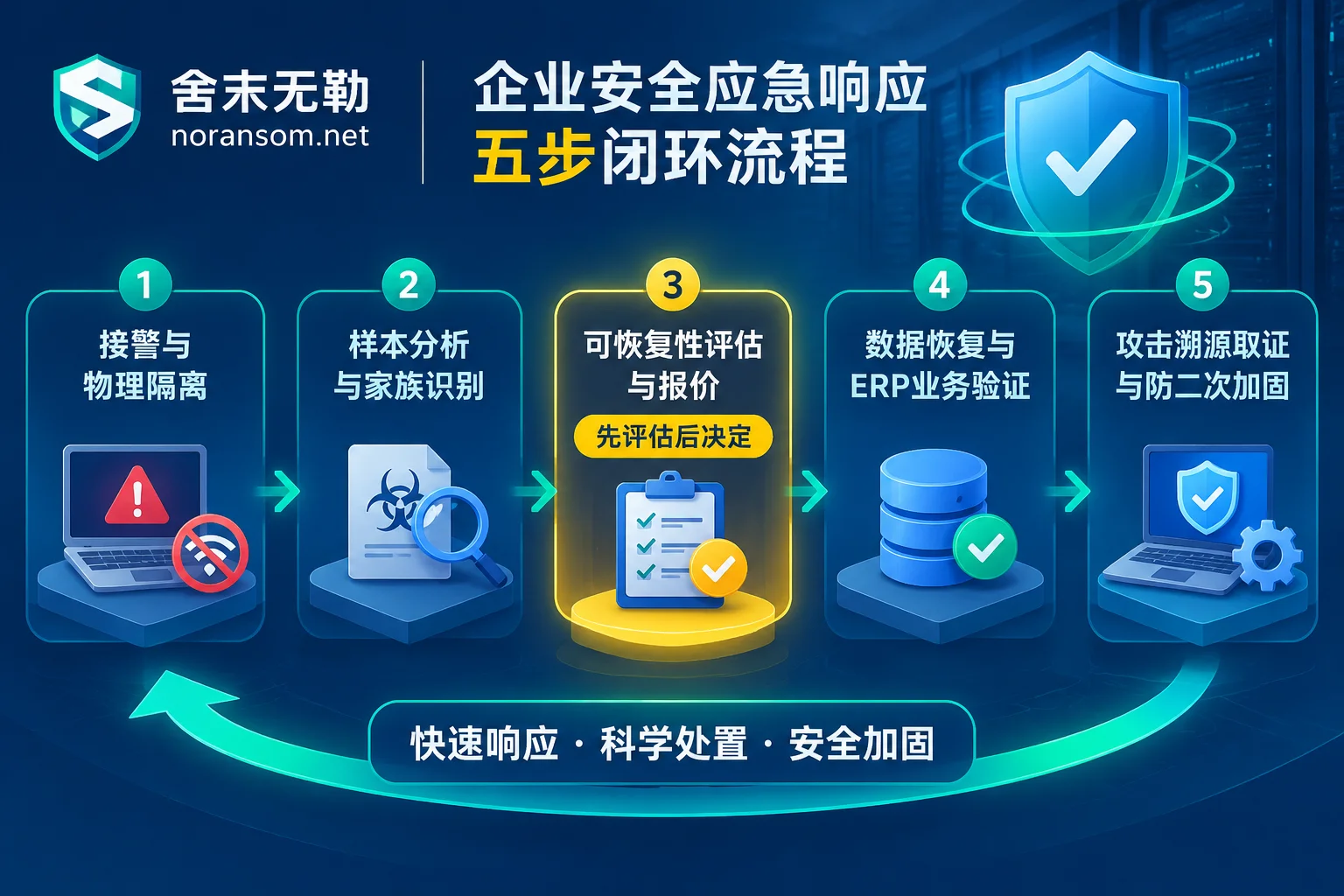
When an enterprise faces a server downtime crisis, the biggest fear is falling into a dilemma of "non-transparent process, arbitrary pricing, and blind-box results". SheMoWuLe implements a standard, transparent five-step Service Process and Quotation Mechanism:
- Incident Reception and Isolation: 7×24 hour rapid response, guiding on-site emergency network disconnection and environment protection to block internal network lateral spread.
- Sample Analysis and Family Identification: Extract encrypted samples, ransom notes, and damaged file characteristics to precisely identify the family and variant version.
- Recoverability Assessment and Quotation: Conduct low-level inspection of damaged databases, virtual machines, or files, clearly informing the recoverable scope, recovery path, and explicit quotation—the assessment conclusion is given to the client first, and then the client independently decides whether to proceed.
- Data Recovery and Business Verification: Execute decryption or file-level repair in an isolated secure environment, mark completeness by system and time point, and assist the client in completing account set and business system mounting verification.
- Tracing, Forensics, and Hardening: Clean up residual Trojans and backdoors, deliver tracing analysis reports, and implement hardening measures to prevent secondary infection.
Conclusion and Emergency Help Channel
In 2026, with vulnerability weaponization accelerating and lateral movement measured in minutes, server ransomware is a severe test of an enterprise's emergency decision-making ability. Facing locked databases and halted production lines, staying calm, protecting the scene, refusing ransom extortion, and engaging a professional team with low-level repair and emergency tracing capabilities is the scientific path to minimizing losses.
If your enterprise is currently experiencing ransomware encryption of servers, databases, virtualization platforms, or ERP account sets, do not operate blindly. You can immediately obtain emergency technical support through the following methods:
- Online Consultation and Reporting Guidance: Visit Contact Us
- 7×24 Hour Emergency Response Hotline: 15639272850
- Emergency Support Email: help@noransom.net


Comments(0)