When core databases report errors and go offline, UFIDA or Kingdee account sets cannot connect, virtual machines are suspended in bulk, and server directories are full of unfamiliar extensions and ransom notes, the first reaction of business leaders and IT operations is often to search online for a ransomware decryption company.
But before hastily making a call for help, decision-makers must recognize two significant changes in the 2026 cybersecurity landscape:
On one hand, attack intensity and complexity continue to rise. The "Cyberspace Security Situation Analysis Report (2026)" jointly released by the National Computer Virus Emergency Response Center and multiple institutions in September 2026 shows that from July 2025 to June 2026, there were 8,819 global ransomware attacks, a year-on-year increase of 40.1%; during the same period, 44 ransomware organizations launched attacks against 164 institutions in China, a year-on-year increase of 76.7%, with industries highly dependent on business continuity, such as manufacturing, particularly hard hit. In the official virus trend reports from late October to early November 2026, families such as Weaxor, Sorry, and C3RB3R remain active, not only implementing high-intensity hybrid encryption against Windows and Linux servers, but some variants also involve credential theft from systems and domains, and the presence of remote-access trojans for data theft.
On the other hand, the handling of security incidents has entered the era of "compliance traceability". Since the implementation of the "National Cybersecurity Incident Reporting Measures", for ransomware attacks reaching certain levels, the operators involved must not only fulfill reporting obligations within specified timeframes (and report to public security authorities promptly if suspected of illegal activities), but also form a closed loop around preliminary cause analysis, attack paths and vulnerability clues, on-site protection, and subsequent remediation summary.
This means that finding a reliable ransomware decryption company today is no longer as simple as "paying for a ready-made key to unlock files". Choosing the right team can maximize the preservation of core account sets and production data, and cleanly cut off risks; choosing the wrong agency may not only miss the golden rescue window but also lead to financial compliance pitfalls and secondary lockouts.
I. Why Finding a "Ransomware Decryption Company" Is Not Equal to Buying a Ready-Made Decryption Tool
Many first-time ransomware victims have a simple question: "With so many ransomware decryption companies on the market, doesn't whoever has a ready-made decryption tool just restore all files in minutes?"
The opposite is true. The National Computer Virus Emergency Response Center has repeatedly warned in multiple alerts: without decryption keys, there is currently no universal recovery method to directly decrypt data encrypted by many active ransomware variants; meanwhile, so-called "ransomware decryption tools or proxy services" spread on search engines and trading platforms are scams that can easily lead to secondary trojan infections or secondary exploitation.
From a cryptographic and engineering perspective, as long as current mainstream ransomware families (such as Weaxor, which uses elliptic curve encryption for AES keys and AES for ChaCha20 keys, or Sorry, which uses AES+RSA double encryption) have no logical flaws in their algorithm implementation and keys are not retained in local memory or elsewhere, no organization can directly "brute-force" a universal decryptor without the private key. Public international projects like No More Ransom or free decryption tools released by some security vendors mainly cover historical family variants with encryption flaws or whose server private keys have been seized by law enforcement (such free public tools are worth checking first, but they are not proprietary to commercial companies).
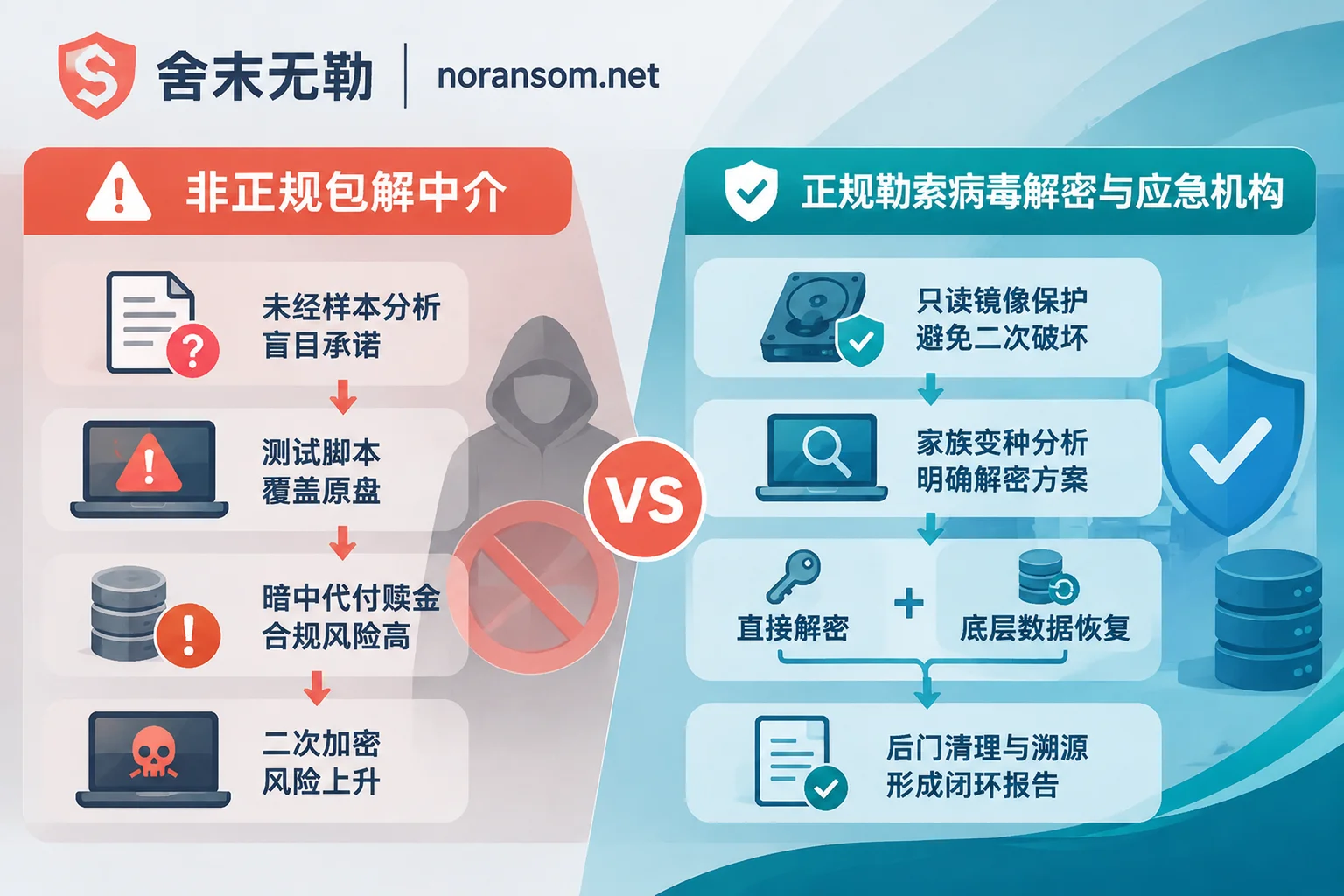
Therefore, if an organization dares to promise over the phone "100% decryption for any extension, delivery in hours" without extracting encryption samples or examining the extent of database corruption, enterprises should be highly vigilant—the other party is either a "middleman" preparing to secretly pay ransom to hackers for a high markup (for risk analysis, see "What to Do After a Ransomware Attack: Don't Be Double-Crossed by 'Low Ransom' and 'Guaranteed Decryption Agents'—A Scientific Self-Rescue Guide"), or simply blindly trying unknown tools from the internet on production drives (see "The 'Decision Maze' After Data Is Locked: Why Blindly Searching for 'Decryption Software' May Actually Increase Losses").
The core competitiveness of a truly professional ransomware decryption company is never a "verbal guarantee", but comprehensive delivery capabilities of "cryptographic analysis and decryption + underlying data engineering recovery + emergency stop-loss and forensic hardening".
II. Five Hard Standards for Evaluating a Ransomware Decryption Company
When enterprise IT and management need to screen external emergency forces in a very short time, they can use the following five specific dimensions as a "touchstone" to quickly distinguish legitimate security emergency service providers from illegitimate intermediaries:
1. Pre-assessment mechanism: "Blind guarantees" or "identification and assessment first, then quotation and decision"?
Different ransomware families—even different iterations of the same family—have completely different encryption logic, file header overwrite ratios, and whether they destroy volume shadow copies. Legitimate service providers will not give a vague promise at the first second they see the extension, but insist on first conducting qualitative and quantitative analysis of encryption samples, ransom note characteristics, and damaged media.
Before formally starting implementation, the service provider should clearly deliver a recoverability assessment conclusion to the enterprise: specifying which family and variant is locked, whether direct decryption conditions exist, what alternative recovery paths are available if direct decryption is not possible, the expected recoverable scope, and potential risks. Laying out the objective situation clearly and giving the enterprise the right to know and decide is the prerequisite for all cooperation.
2. Technical depth: When direct decryption is not feasible, does it have underlying data recovery and business verification capabilities?
For enterprises, the truly fatal issue is often not a few ordinary office spreadsheets being locked, but the paralysis of databases, ERP, and virtualization layers that carry the lifeblood of the business. When facing new variants that cannot be directly reverse-engineered at the algorithm level, organizations that can only run ready-made scripts will be helpless; teams with underlying data engineering capabilities will immediately switch to multi-path rescue:
- Database file-level repair: For SQL Server and other database MDF/NDF data page structures, analyze the proportion of encrypted-overwritten pages (many ransomware families, to speed up encryption, use interval encryption or only encrypt the header of very large files), and reassemble, extract, and logically verify undamaged data pages.
- Virtualization and storage underlying extraction: For VMware ESXi, Hyper-V hosts, or Synology NAS storage volumes, distinguish whether the host underlying volume is locked or the virtual machine is infected, and rescue core business images from flat volumes, residual blocks, and disk space not fully overwritten.
- Backup, snapshot, and fragment reassembly: When local backups appear deleted or encrypted, investigate underlying unallocated space, historical snapshot remnants, and file fragments, and truthfully annotate data completeness by business system and time point, cooperating with the enterprise to complete account set mounting and business verification, rather than returning a bunch of unreadable half-finished files.
3. Compliance bottom line: Does it explicitly refuse "ransom payment on behalf" and black-market negotiations?
Under increasingly strict corporate compliance and internal control audits, "paying virtual currency to overseas ransomware gangs through intermediaries" hides multiple risks: first, legal and audit risks from cross-border unknown fund flows; second, even if payment is made, the decryptor sent back by hackers may still damage large databases due to coding flaws, or retain stolen data for secondary extortion; third, paying enterprises will be marked by the black market as "highly willing to pay targets".
A legitimate ransomware decryption company will strictly adhere to technical and compliance boundaries: not paying ransoms, not negotiating with attackers on behalf, and every service investment is used for sample reverse analysis, underlying data rescue, and system security reconstruction.
4. Emergency collaboration: Only fixing files, or also cleaning latent remote control and stolen credentials?
Many enterprises have suffered this: after painstakingly restoring ERP account sets online, the server was locked down again within three days. The reason is simple—ransomware encryption is only the "last step" of the entire attack chain.
Take recent high-incidence attacks as an example: some Weaxor samples on Windows platforms have the function of stealing local system and domain login credentials; many enterprises were initially infected because financial or administrative office computers mistakenly installed a Silver Fox trojan disguised as an office tool, and attackers silently monitored for a long time, mapped the internal network topology and backup locations, and then concentratedly deployed ransomware late at night. If the service provider only knows how to repair data but not emergency response, does not investigate resident backdoors, scheduled tasks, abnormal accounts, and compromised sessions (antivirus software not reporting a virus does not mean it is clean; see "Why Ransomware Data Recovery Is Followed by Re-Encryption: Rescuing Data Is Only the First Step, Don't Rush to Go Online Before Cleaning These Four Types of Backdoors"), the restored system is essentially "running naked" under the attacker's nose.
5. Evidence and closed loop: Can it preserve the scene and produce a traceability report usable for reporting and compliance?
After a ransomware attack, some non-professional repair personnel habitually format the system drive and reinstall the environment right away, causing the attacker's login logs, PowerShell execution records, and memory residency traces to vanish. This not only leaves the enterprise forever ignorant of "how the hacker got in and whether customer and R&D data were stolen", but also leaves the enterprise with no traceability clues when reporting to public security authorities or fulfilling regulatory reporting requirements.
A qualified security emergency team must follow the iron rule of "stop loss first, then forensics, then recovery": under the premise of read-only protection of original evidence, restore the intrusion entry point and attack timeline based on logs, disk images, and memory evidence, objectively determine whether there are signs of data leakage, and assist the enterprise in shrinking external exposure and rebuilding tamper-proof backups.
III. How She Mo Wu Le Builds a Standardized Emergency and Recovery Loop for Affected Enterprises
As a professional emergency response brand under Zhengzhou She Mo Information Technology Co., Ltd., She Mo Wu Le (noransom.net) focuses on emergency response services for ransomware and Silver Fox/remote-control trojans, serving enterprises and individuals who have been infected or highly suspect infection (including business leaders, IT operations, financial cashiers, and ordinary office users). We adhere to not paying ransoms, not negotiating on behalf, do not make exaggerated promises that violate objective technical laws, and always advance each rescue with the transparent principle of "identify the family first, assess the recoverable scope, then provide a plan and quotation".
Centered on the full-cycle needs of enterprises from sudden shutdown to safe business reconnection, She Mo Wu Le provides a technical service system with clear modules that can be connected as needed:
- Free self-service initial screening and family intelligence verification
After discovering file anomalies, operations personnel can immediately use the free ransomware identification tool (or consult the encryption extension list), enter the encryption extension or ransom note file name to quickly locate the suspected family; at the same time, they can check the ransomware database for identification features, propagation methods, and current recoverability descriptions of common families such as Weaxor, Mallox, Sorry, Makop, Phobos, and LockBit (the latest decryption support for each family is subject to real-time information on the virus database page). - Scenario-based decryption assessment and underlying data rescue
For enterprises with damaged servers, databases, and virtualization platforms, the ransomware decryption service accurately identifies variant versions and issues a recoverability assessment (covering recoverable scope, optional paths, expected results, and risks). When direct decryption is not feasible, it seamlessly connects to data recovery services, around complex enterprise emergency solutions such as SQL Server database encryption, ESXi / Hyper-V virtual machine encryption, Synology NAS encryption, UFIDA/Kingdee/Guanjiapo/Suda/SAP ERP encryption, backup deletion or corruption, and domain controller compromise and network-wide encryption, carrying out snapshot repair, database file-level repair, and fragment extraction, and delivering with clear completeness annotations by system and time point. (Note: If subsequent commercial licensing, version upgrades, and official patch installation of ERP software are involved, it is recommended to contact the corresponding software vendor or authorized agent directly; this site has no cooperative relationship with relevant ERP vendors.) - Stop loss, backdoor cleanup, traceability forensics, and long-term hardening
Relying on the 7×24 hour response security emergency response mechanism, supporting remote and on-site collaborative handling, quickly isolating compromised nodes and cleaning resident remote control (if investigation reveals accompanying remote-control data theft and financial fraud risks, a special Silver Fox handling can be started simultaneously, dealing with host cleanup, account sessions, and financial risks separately; if fraudulent transfer has occurred, please contact the bank immediately for emergency stop-payment and report to public security authorities). On this basis, through attack traceability forensics, restore the intrusion chain, determine data leakage risks, and issue a forensic report usable for reporting and compliance reporting, and finally cooperate with security hardening protection to tighten remote access, patch high-risk vulnerabilities, converge permissions, and rebuild isolated backups that cannot be easily deleted.
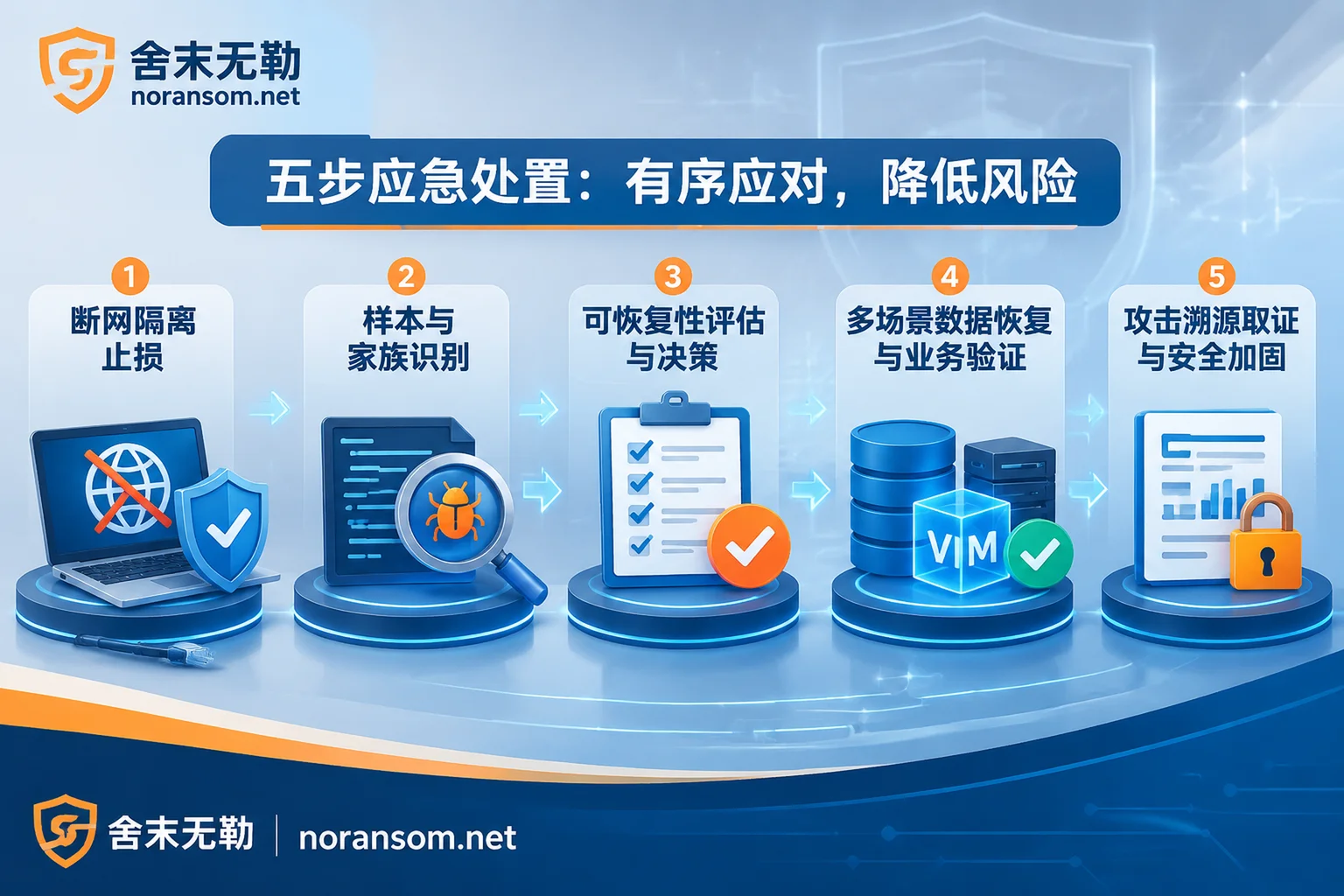
In terms of cooperation experience, She Mo Wu Le strictly implements a standardized five-step service process and quotation specification: alert and isolation → sample analysis and family identification → recoverability assessment and quotation → data recovery and business verification → traceability forensics and hardening. All core assessment conclusions are delivered to the customer first, and the customer decides independently whether to enter the formal implementation stage based on their own business priorities and recovery expectations.
IV. Before Contacting a Decryption and Recovery Team, Keep These Three On-Site Red Lines
Regardless of which technical team you ultimately choose, in the first hour after discovering encryption, protecting the scene is often more decisive for data survival than blind operations (for a checklist of on-site information to prepare in advance, see "Before Looking for a Ransomware Recovery Company, Prepare These Five Types of Materials First"):
- Immediately disconnect physically, but be cautious about shutting down or restarting: Immediately unplug the network cable of the infected server or disconnect the switch port, disable Wi-Fi, and block lateral spread; but do not arbitrarily force restart or frequently power cycle, to avoid destroying key forensic clues in memory or triggering secondary overwrites by incomplete encryption processes.
- Prohibit running any modification, antivirus, or test scripts on the original disk: Do not manually batch-modify encrypted file extensions, do not forcefully attach or repair damaged databases, and do not let antivirus software directly shred the only ransomware sample and ransom note—all analysis and repair must be performed on read-only images or independent copies.
- Check and physically isolate remaining backup media: Immediately check whether off-site backup servers, NAS, and portable hard drives are still mounted online; if not yet affected, physically disconnect them immediately to preserve the last fallback.
In the face of a sudden ransomware attack, calmly protecting the scene, refusing ransom kidnapping, and choosing a professional team with transparent processes and underlying data recovery and traceability closed-loop capabilities is the rational path to minimizing business losses. If your servers, databases, ERP account sets, or office intranet are suffering from encryption shutdown and remote-control trojan threats, you can obtain one-on-one response support through She Mo Wu Le's emergency contact channel (24-hour emergency hotline: 15639272850, email: help@noransom.net), to first complete sample identification and recoverability assessment, and steadily advance business reconnection.


Comments(0)