In today's network environment, when enterprise IT operations personnel or managers open a server and find that all business data extensions have changed to a string of unfamiliar characters, their first reaction is often to open a search engine and search for "ransomware decryption tools".
However, this behavior of "seeking any remedy in desperation" is exactly what black industry practitioners are most happy to see. In cyberspace, most so-called "one-click decryption software" are superficial, and may even hide Trojans for secondary encryption or data theft. Real ransomware handling is never as simple as clicking a button.
Misconceptions You Need to Step Out of When Facing Encryption
Many victims try to solve the problem by looking for free tools, but the reality is:
- Huge differences between families: Different ransomware families (such as Mallox, Phobos, LockBit, etc.) have completely different encryption logic, and there is no universal "master key".
- Rapid evolution of variants: Virus authors continuously iterate algorithms. Even within the same family, versions at different times may cause decryption failure or data corruption.
- Secondary damage: Executables from unknown sources may destroy existing data fragments, resulting in permanent data damage even if decryption becomes possible in the future.
Scientific Decision-Making: A Professional Process Starting with Identification
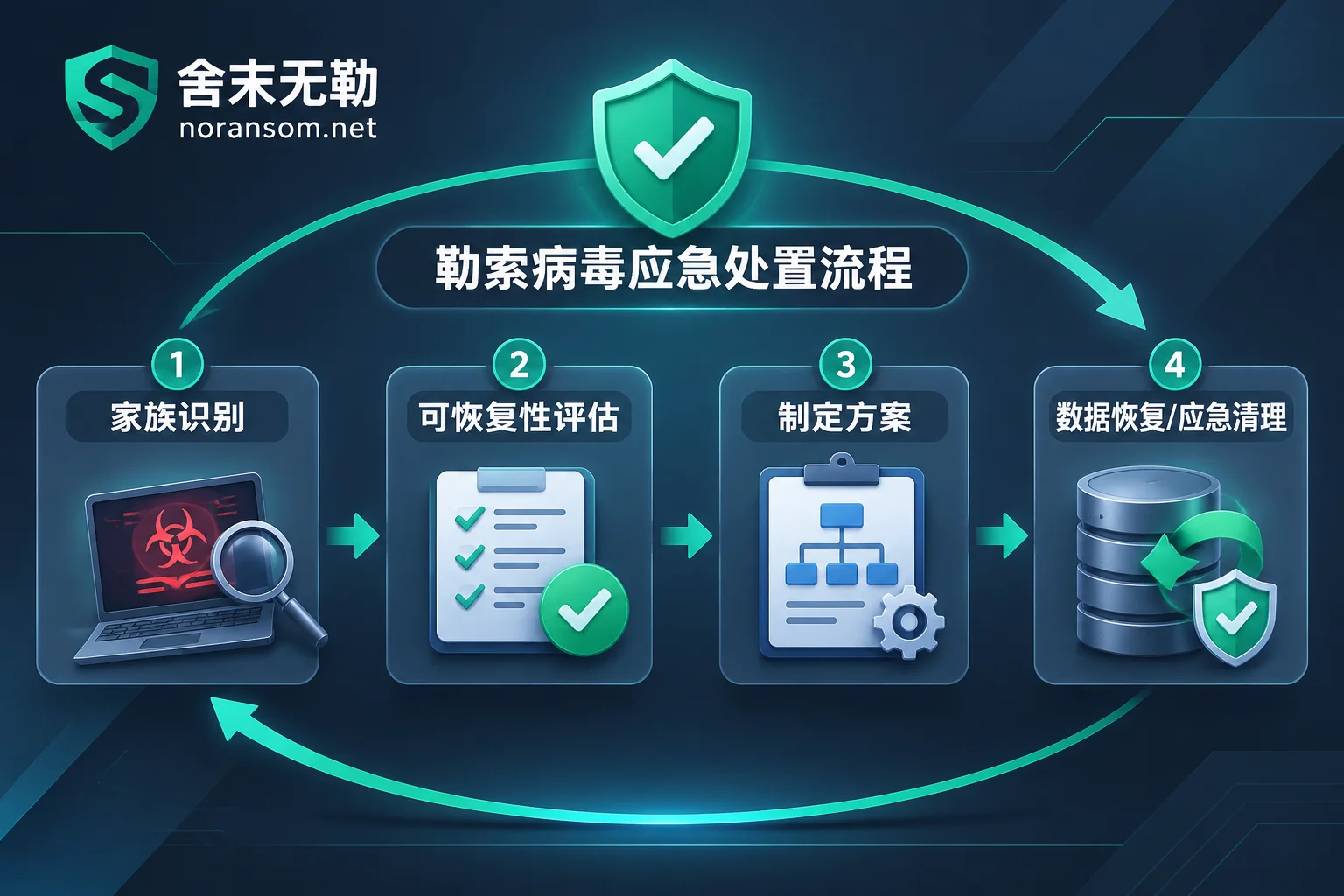
Rather than wasting time looking for a non-existent "one-click decryption", it is better to adopt a scientific emergency response process. In Shemowule's practice, we always adhere to the principle of "evaluate first, decide later":
- Step 1: Precise family identification: Enter the encryption extension through an online tool to first determine the virus type. This is the prerequisite for judging whether recovery is possible.
- Step 2: Recoverability assessment: Data recovery does not necessarily require "decryption". When the encryption algorithm cannot be directly cracked, data recovery services will attempt to rescue core assets through technical means such as backup repair and residual fragment extraction.
- Step 3: Customized solutions by scenario: For different environments such as SQL Server databases, virtual machines (ESXi/Hyper-V), or ERP systems, the rescue paths are fundamentally different.
Security Is Not Just Recovery, but Also "Eradicating the Root"
Many enterprises are encrypted again just a few days after data recovery. The core reason is that "the backdoor was not cleaned thoroughly". Professional security emergency response not only focuses on data recovery but also on cleaning the environment.
We do not provide assistance in paying ransoms, nor do we negotiate on behalf of victims. Our value lies in: identifying threats, assessing risks, fixing vulnerabilities, and ensuring that your business environment no longer becomes a "backyard" where hackers can enter and exit at will after recovery.
Final Words
When a ransomware crisis occurs, please stay calm. We recommend that you first check the ransomware database to evaluate the current damage by reviewing the characteristics of common families. If you are facing an emergency with business interruption, please follow the standard handling process and have professionals intervene to find the optimal recovery path without damaging data.
For more practical prevention of ransomware and Silver Fox Trojans, please continue to follow our blog for the latest emergency guides.



Comments(0)