When you arrive at the office in the morning and open the server, only to find that the financial accounts, business database, and shared directories are all unreadable, with files uniformly renamed to unfamiliar extensions such as .sorry, .wxx, or .rox, and a ransom note demanding virtual currency pops up on the desktop—when faced with such an emergency, whether you are a company executive, IT operations staff, or finance personnel, the first question that comes to mind is often: What should I do if I'm hit by ransomware?
In their reports, police and security agencies have highlighted an easily overlooked trend: the current ransomware black market has long broken the rule of 'targeting only large enterprises' and has generally shifted to 'small profits but quick turnover.' Nearly 70% of domestic ransomware cases have ransom demands concentrated between 10,000 and 50,000 RMB. It is precisely this seemingly 'bearable' amount, coupled with the anxiety of business stoppage, that leads many victims to fall into a chain of traps in their panic: ransom fraud, exploitation by payment intermediaries, or on-site destruction.
Combined with the 'two dos and three don'ts' principles summarized by the police after an infection (do immediately disconnect the network and isolate without shutting down; do protect on-site evidence and report to the police; don't trust online decryption tools and decryption agents; don't easily pay the ransom; don't rush to format and reinstall), this article will break down a clear, actionable self-rescue plan from two dimensions: 'how to avoid secondary exploitation traps' and 'how to maximize the rescue of core business using technical means.'
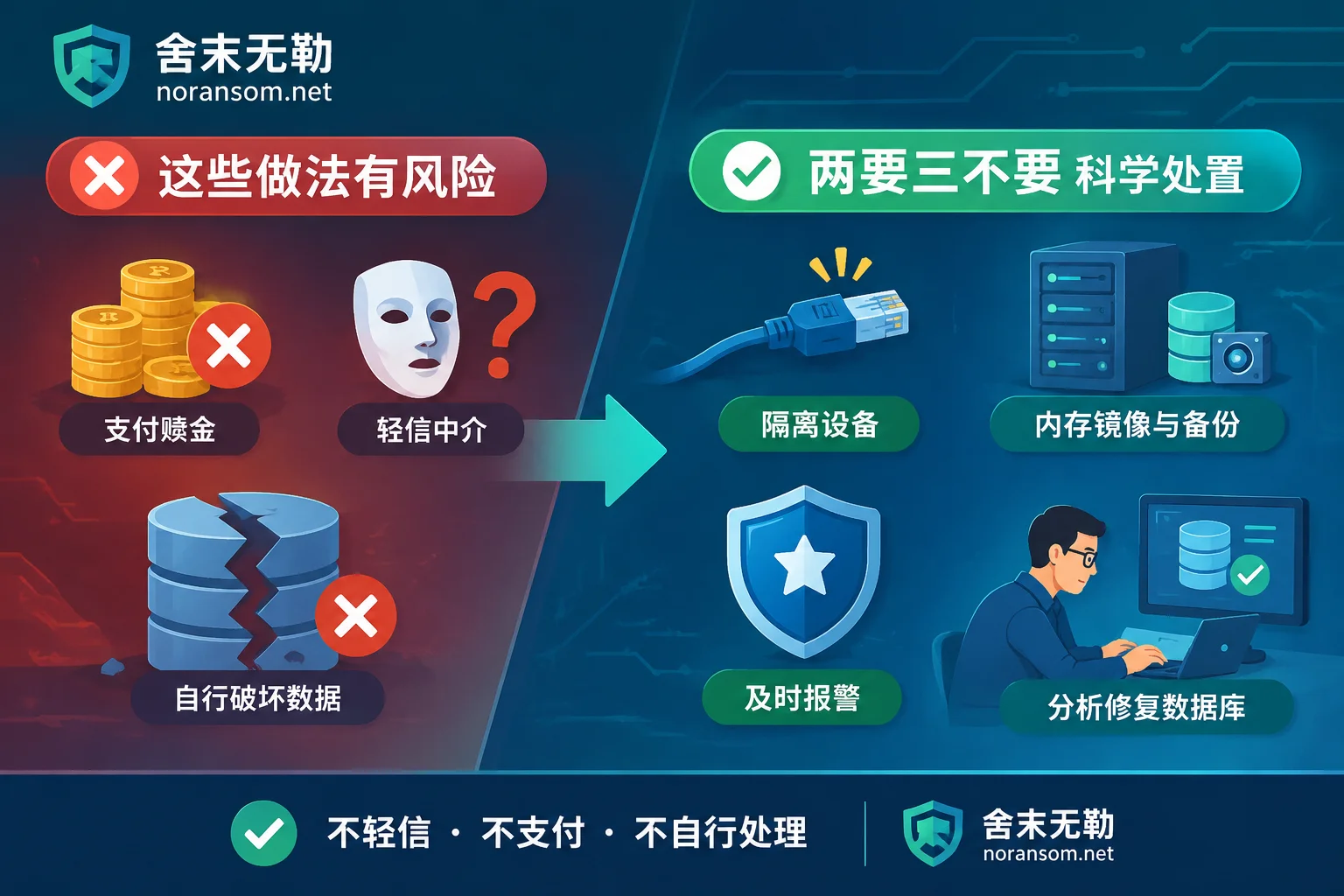
I. Breaking Two Fatal Illusions: Why 'Pay to Escape Disaster' and 'Find an Agent for Guaranteed Decryption' Don't Work
When core business is halted and calls urging recovery keep coming, many corporate managers waver: 'Since the ransom is only a few tens of thousands, can we just pay and get the key, or find an organization online that claims '100% guaranteed recovery' to handle it?'
In actual emergency response scenarios, these two paths often lead to more severe losses:
1. Paying the ransom doesn't mean getting data back; instead, you'll be tagged as a 'fat sheep'
The sole purpose of black market gangs is to extort money, not to fulfill business contracts. After paying the ransom, victims often face three outcomes:
- Disappearing immediately after receiving payment: The attacker takes the virtual currency and directly blocks communication channels, or sends an invalid decryptor that doesn't work at all.
- Price gouging and double extortion: Some attackers steal high-value data from the internal network in batches before encryption. Once they find the enterprise pays readily, they immediately threaten to 'publish client information and financial secrets' to demand a second payment.
- Backdoors left behind to detonate again: As long as the attacker has mastered the original intrusion channel and internal network permissions, it's common for them to lock the system again with a variant weeks later.
2. Beware of 'ransom payment intermediaries' disguised as tech companies
When searching for 'what to do if hit by ransomware,' the internet is flooded with individuals or intermediaries under the banner of 'unconditionally cracking any new variant.' In reality, when the encryption algorithm is rigorous and the asymmetric key length reaches 2048 bits or more, it is impossible to brute-force crack without the private key given current computing power.
Those so-called 'decryption agents' who pat their chests and guarantee '100% full decryption' often secretly take the victim's ransom note to negotiate with the hacker and earn a hefty margin. Once the hacker takes the money and doesn't provide the key, the intermediary shirks responsibility; worse, without any image backup, they directly test dubious tools on the original disk, causing database files that could have been repaired through low-level structure recovery to be completely corrupted beyond repair.
Professional Code Note: Legitimate security emergency response organizations never act as 'money laundering channels' for the black market. Take SheMoWuLe as an example: we strictly adhere to the principles of not paying ransoms and not negotiating with attackers on behalf of clients during handling. We also do not make false guarantees of '100% recovery without examining samples.' All rescue plans are based on rigorous family identification and low-level recoverability assessment.
II. Hold Your Ground: Practice 'Two Dos and Three Don'ts' to Preserve the Chances for Data Rescue
If you have already read our "What to Do If Hit by Ransomware: A Complete Emergency Decision Checklist from the First 30 Minutes of Loss Control to Business Resumption", you'll know that every mouse click in the early stages determines the final recovery rate. Before professionals intervene, please strictly execute the following on-site protection actions:
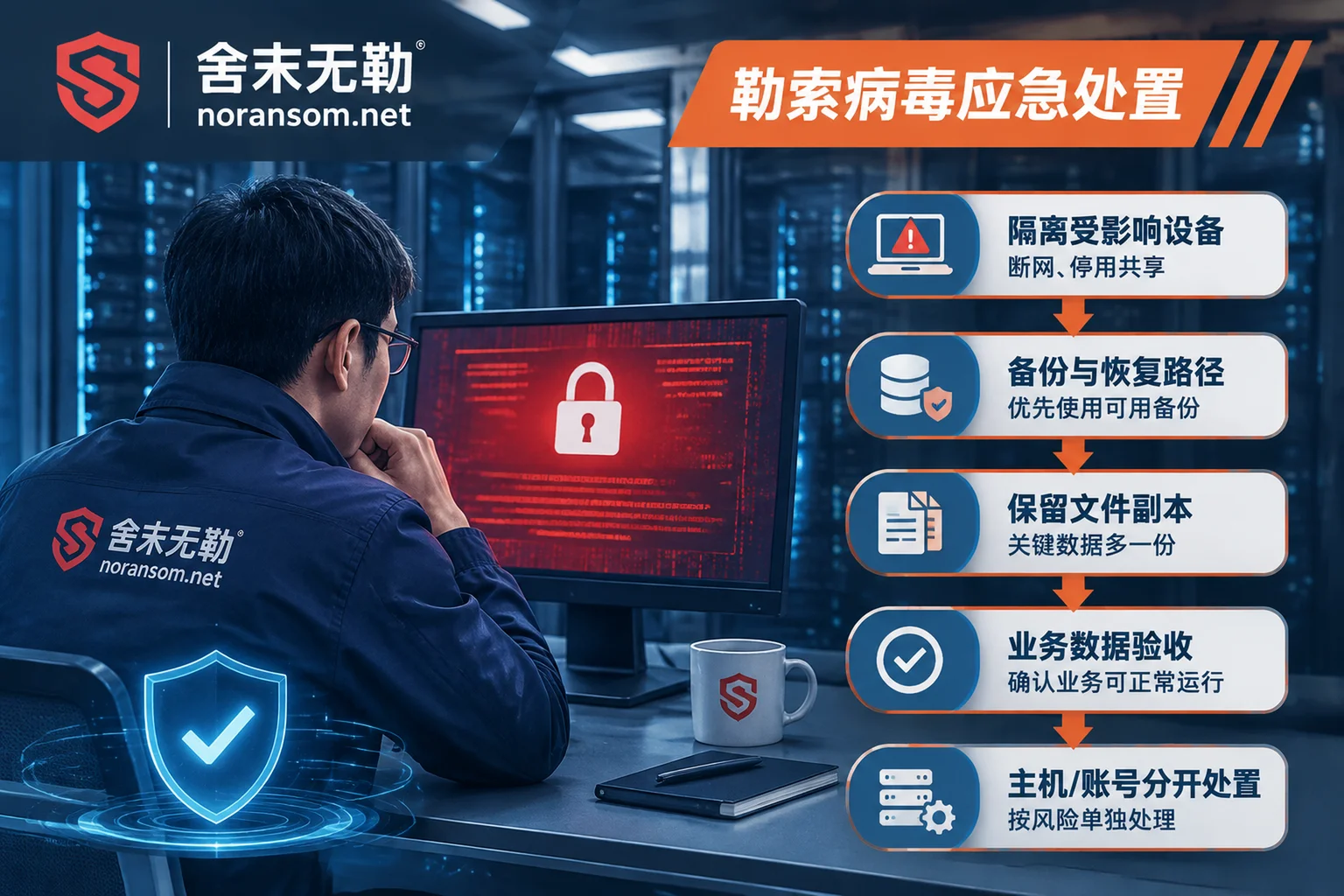
- Physically disconnect the network but keep the machine powered on: Unplug the network cables of infected servers and terminals, disable Wi-Fi, or directly isolate the infected VLAN on the core switch, cutting off connections to NAS and backup storage. Remember not to directly unplug the power or restart the system—restarting not only clears residual processes, network connections, and encryption clues in memory but may also trigger boot scripts of some viruses that further encrypt remaining unencrypted files.
- Investigate hidden remote control to prevent 'explosions while investigating': In recent years, many internal network ransomware attacks (such as some
.bresor LockBit attacks) did not directly exploit vulnerabilities but started with employees infecting their office computers with remote control Trojans disguised as office software or financial tools. If you suspect silent remote control activity in the internal network, refer to "Office Computer Remotely Controlled Without Notice? Beware of the Latent Attack Chain from Silent Remote Control to .bres Ransomware Outbreak". When necessary, conduct a Silver Fox Trojan special investigation on key terminals, separating host cleanup, account sessions, and financial risk handling. - Preserve key evidence and report to the police simultaneously: Keep the original ransom note on the desktop or directory (do not delete or modify), record the complete tampered extension names, and protect system logs and antivirus quarantine areas. At the same time, report to the local public security organ as soon as possible, and immediately contact the bank to stop payment if there is a risk of fund theft.
III. Scientific Assessment: Without Paying a Ransom, How Exactly Can Data Be Recovered?
After disconnecting the network to stop the loss, the core question returns to 'how to recover data.' Different ransomware families and different business carriers (databases, virtual machines, or ordinary documents) have vastly different rescue paths.
Step 1: Accurately identify the ransomware family and variant
Don't jump to conclusions based only on the last few letters of the file extension. You can directly use the free online tool provided by SheMoWuLe—Ransomware Identification—enter the extension of the encrypted file or the ransom note file name to quickly query the family; you can also refer to the Ransomware Extension Query Table and Ransomware Database to understand the propagation characteristics of the family.
For example, the recently frequently warned Weaxor ransomware (common extensions .rox / .weax / .wxx), the continuously evolving Sorry ransomware, and the Mallox ransomware that frequently targets databases, have different encryption logics (full disk encryption, header encryption, or intermittent encryption). In addition, for some older families or specific variants that have been cracked, third-party public welfare projects jointly maintained by Interpol and the security industry (such as No More Ransom) may provide public free decryption tools; after confirming version compatibility, you can try them first.
Step 2: Distinguish technical paths—'ransomware decryption' vs. 'low-level data recovery'
When facing new variants where public free tools are ineffective, professional teams will strive for maximum data integrity through two paths:
- Ransomware Decryption: Conduct in-depth sample reverse engineering and algorithm analysis for specific families and variant versions, assess whether there are implementation flaws or exploitable decryption paths, and provide a clear recoverable scope, expected results, and risk assessment.
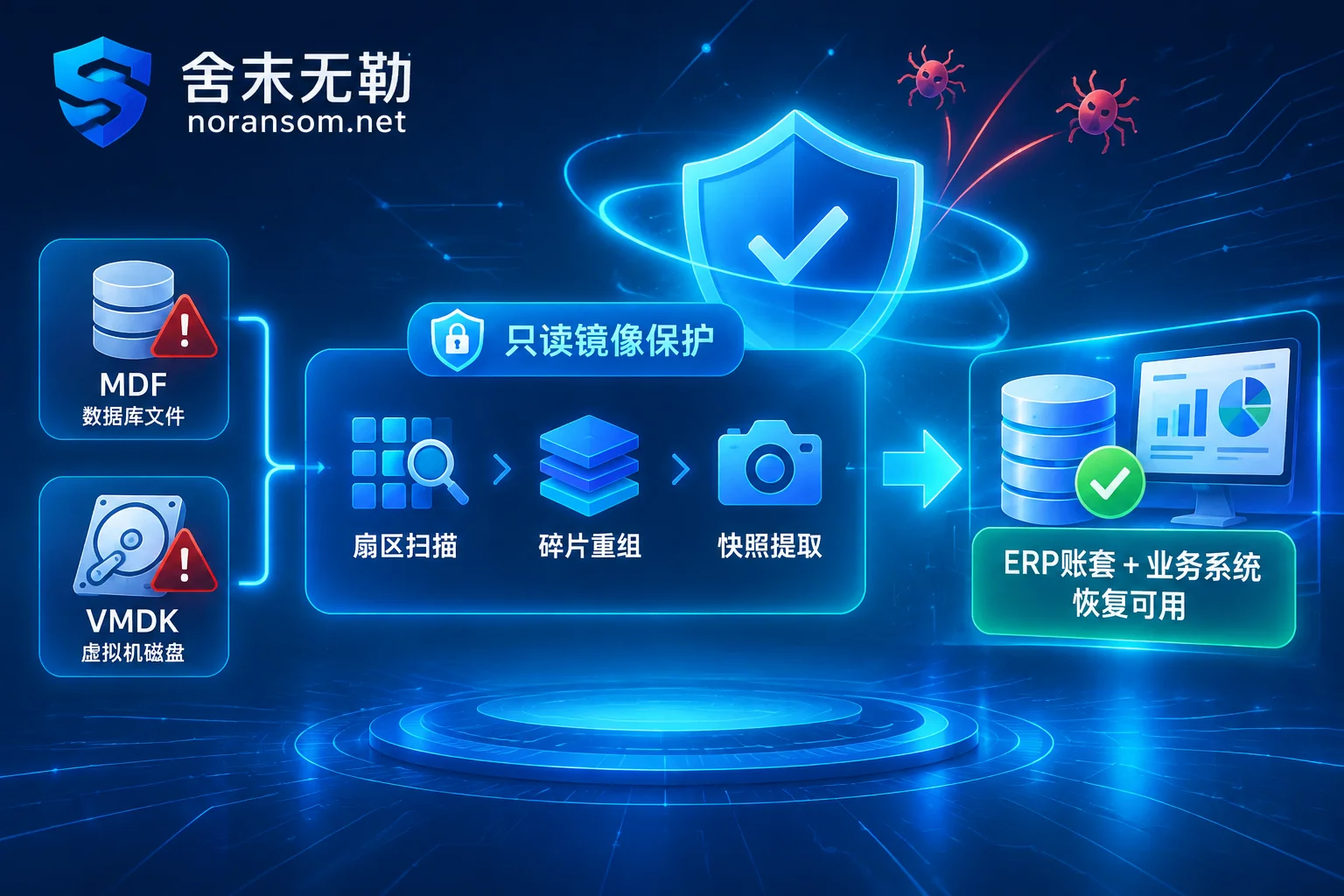
- Data Recovery: When the encryption algorithm itself cannot be directly reverse-engineered, it does not mean the data is completely lost. Because many ransomware viruses, in pursuit of encryption speed, only encrypt the file header or use block-skipping encryption for large database files (such as
.mdf,.ndf) or virtual disk files (such as.vmdk,.vhdx), the vast majority of original data pages remain at the bottom of the file. At this point, data can be rescued through backup and snapshot repair, database file-level low-level repair, extraction of unencrypted remnants and disk fragments, and delivered with completeness annotated by system and time point.
Step 3: Apply targeted remedies for core business scenarios
An enterprise's most critical assets are often concentrated in a few key systems, and SheMoWuLe provides targeted scenario-based solutions for this:
- Database and ERP account set rescue: When encountering SQL Server encrypted, do not force-attach the error-reporting MDF file (see "Don't Make These Five Mistakes After a Server Ransomware Infection: Only with On-Site Protection Can Databases and Virtual Machines Be Rescued"). For ERP encryption scenarios involving UFIDA U8 / NC / Chanjet T+, Kingdee K/3 / KIS / Cloud Cosmic, GuanJiaPo, SuDa, SAP, etc., engineers can extract and reconstruct table structures and core account set data from read-only images (Note: If ERP software licensing, upgrades, or official patch installation are involved after data recovery, please contact the corresponding software vendor or agent).
- Virtualization and storage rescue: For ESXi / Hyper-V virtual machines encrypted and Synology NAS encrypted, extract key business virtual machines and shared documents by analyzing low-level volume structures and residual snapshots.
- Extreme scenario fallback: Even in cases of backup deleted or corrupted by attackers who cleared copies in advance, or domain controller compromised and entire network encrypted, core business operations can be gradually restored through sector-level scanning and domain controller permission reconstruction.
IV. Refuse Secondary Recurrence: Clean Backdoors First, Then Bring Business Online
Many enterprises finally recover their account sets and drawings through technical means, then hastily reconnect servers to the internal network, only to be locked again within two days. We have repeatedly emphasized in "Why Ransomware Data Recovery Is Followed by Re-Encryption: Rescuing Data Is Only the First Step; Don't Rush Online Until These Four Types of Backdoors Are Cleaned": If the entry point is not sealed, credentials are not changed, and persistence is not cleared, you must never restore online.
A complete closed-loop handling must advance the following three steps simultaneously with data rescue:
- Security Emergency Response: Follow the iron rule of 'stop loss first, then forensics, then recovery,' comprehensively investigate traces of lateral movement within the internal network, thoroughly remove hidden accounts, scheduled tasks, webshells, service items, and remote control Trojan persistence left by attackers, and block the possibility of secondary encryption.
- Attack Traceability and Forensics: Based on system logs, disk images, and memory evidence, accurately reconstruct the hacker's initial intrusion entry point (such as weak password RDP brute force, unpatched OA/VPN vulnerabilities, or phishing Trojans) and the complete attack timeline, determine whether sensitive data has been leaked, and issue a forensic report usable for police reporting and corporate compliance disclosure.
- Security Hardening and Protection: Assist enterprises in comprehensively reducing external exposure, governing network-wide passwords and remote access policies, patching high-risk vulnerabilities, tightening domain and host permissions, and rebuilding an offline isolated backup system that attackers cannot easily delete.
V. Assess First, Decide Later: How to Get Transparent and Reliable Emergency Support?
In the face of ransomware, blind operations and desperate measures are the biggest costs. To ensure every minute of rescue time is spent effectively, SheMoWuLe adopts a fully transparent standardized service process and pricing mechanism:
- Incident response and isolation guidance: Immediately guide on-site personnel to complete scientific network disconnection and evidence preservation to prevent loss expansion.
- Sample analysis and family identification: Analyze ransom notes, encrypted samples, and the low-level structure of damaged files.
- Recoverability assessment and quotation: Before formal implementation, deliver a clear assessment conclusion to the client (specifying what can be recovered, which technical path to take, expected completeness, and corresponding quotation), and the client decides independently whether to proceed based on the assessment conclusion.
- Data recovery and business verification: Complete repairs in an image environment, and the client personally verifies the usability of database account sets and key files.
- Traceability, forensics, and security hardening: Eliminate internal network hazards and safeguard business security for re-online.
If your enterprise servers, databases, ERP systems, or office computers are currently suffering from ransomware or Silver Fox Trojan attacks, please keep the infected devices in their current state, prepare screenshots of the ransom note and 1-2 samples of damaged files, and obtain one-on-one preliminary assessment and emergency support through the Contact Us page, by calling the 24-hour emergency hotline 15639272850, or by sending an email to help@noransom.net.



Comments(0)