On the front lines of domestic government and enterprise cybersecurity emergency response, if there is a type of ransomware that can simultaneously trouble database administrators and finance leaders, Mallox ransomware (early also known as TargetCompany or FARGO) is definitely on the list.
According to multiple security posture statistics, since entering 2026, the Mallox family has not only not disappeared but has derived highly active branches (such as Weaxor) through architectural restructuring and "rebranding," and further expanded attack variants targeting Linux platforms and NAS devices. When .mdf databases, .bak backup files, and engineering drawings on enterprise servers are overnight given unfamiliar extensions, and ransom notes like FILE RECOVERY.txt or HOW TO RECOVER FILES.TXT appear in directories, a race against time involving business downtime and data rescue has already begun.
Previously, in "Mallox and .bres Ransomware Outbreaks: When Databases, NAS Shares, and Backup Drives Are Simultaneously Compromised, How Can Enterprises Rescue Core Data?" we discussed emergency coordination for simultaneous multi-storage media disasters. This article takes a different perspective and deeply dissects the evolution of the Mallox family's intrusion chains in 2026, the high-frequency suffix disguise mechanism, and why "copying old online decryption tools" is becoming the driver of complete enterprise data destruction.
I. The Top Threat Wearing a Dozen "Vests": The Homologous Maze of Mallox and Weaxor
When many enterprise IT operations discover their servers are locked, their first reaction is to search the internet for the tampered file extension. However, in the 2026 attack wave, this approach often leads to information fog.
The early Mallox family had very distinct characteristics, with encryption suffixes concentrated in .mallox, .malox, .rmallox, or .malloxx. But to counter signature-based detection by security software and create retrieval obstacles for victims, the attack gang adopted a "maze strategy" of frequently changing suffixes. In particular, its rebranded branch Weaxor ransomware (for the latest developments of this branch, see "Weaxor Ransomware Mutates Again: Data Rescue Survival Rules After Business Interruption"), while retaining Mallox's core attack genes, has evolved more than ten suffix variants such as .weax, .rox, .wxx, and .wxr.
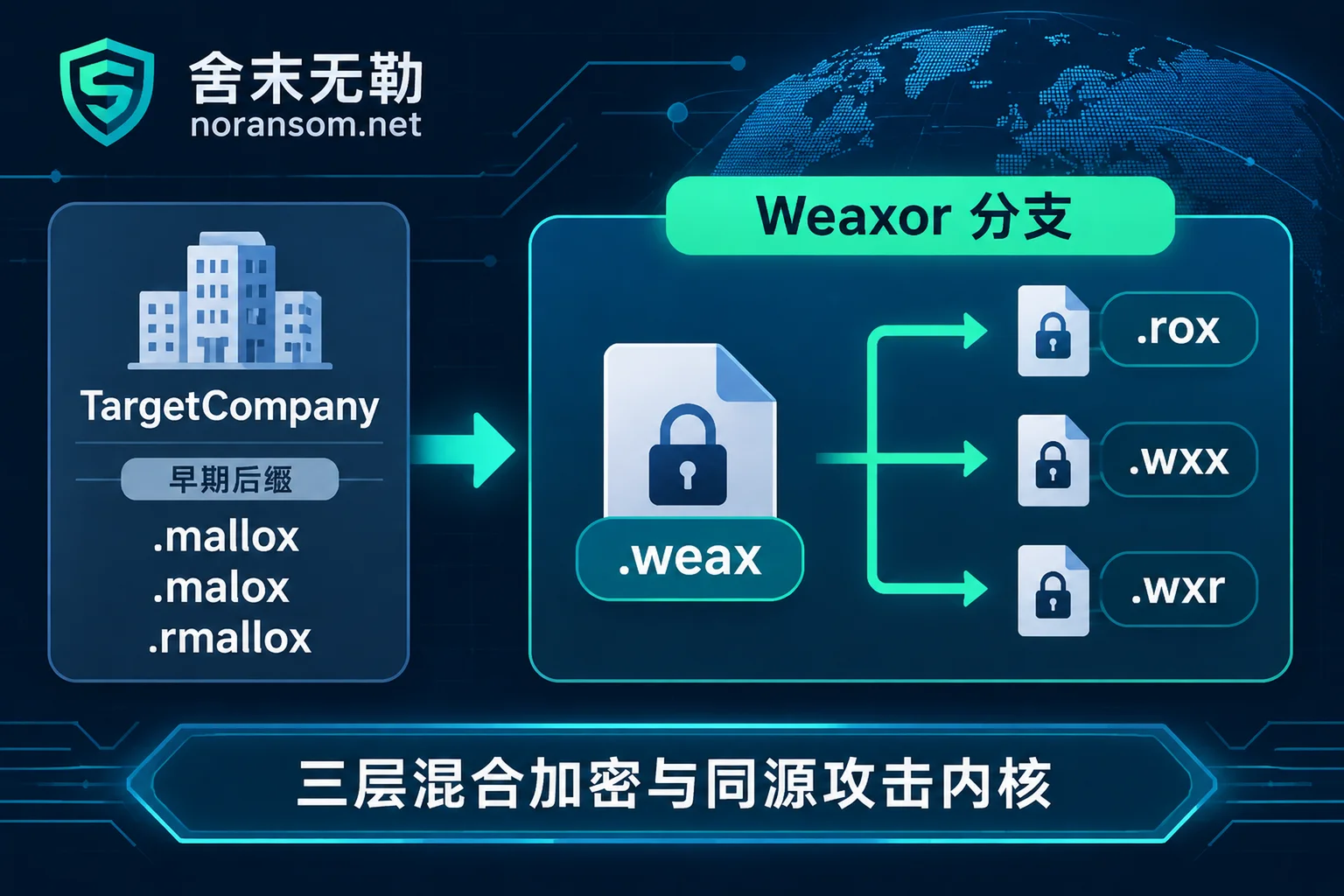
This also explains why we repeatedly emphasized in "2026 Ransomware Suffix Evolution and Recovery Truth: Why Do Different Enterprises Have Completely Different Data Outcomes with the Same Encryption Suffix?": It is no longer possible to accurately determine the underlying encryption logic just by looking at the suffix letters.
At the encryption algorithm level, the Mallox family has undergone upgrades from early AES/ChaCha20 combinations to today's multi-layered nested structures integrating elliptic curve algorithms, AES, and ChaCha20. More dangerously, many enterprises, after finding outdated information online that "Mallox has a free decryptor," blindly download third-party tools and run them directly on production drives. Little do they know that public free decryptors are only applicable to earlier specific historical versions; when facing new variants with reconstructed key logic in 2026, forcibly using mismatched decryption tools can easily destroy the header structure and tail verification information of encrypted files, directly cutting off the possibility of subsequent professional rescue.
Therefore, the first step after an infection is by no means blind trial and error. Instead, use professional ransomware identification tools or search the ransomware suffix query table, combined with ransom note characteristics and sample hashes, to precisely identify the specific family branch and generation. For the basic profile of this family and current recoverability boundaries, you can also directly consult the Mallox Ransomware Database Page.
II. Why Are Core Accounting Systems and Databases Always the First to Be Hit? Dissecting Three Classic Intrusion Chains
Unlike other widespread phishing Trojans, the Mallox family has strong "business targeting." Reviewing various industry alerts and security posture reports in 2026, the reason this family can frequently devastate manufacturing, trading, and healthcare institutions mainly relies on the following three mature automated and manual penetration chains:
1. Port 1433 Exposure and MS-SQL Database Brute Force
This has been Mallox's core "signature skill" since its inception. Attackers use internet-wide scanners to find Microsoft SQL Server default port (1433) exposed to the public internet, and launch automated weak password brute force attacks against high-privilege accounts like sa. Once the password defense is breached, attack scripts enable xp_cmdshell stored procedures or exploit SQL CLR assemblies to directly pull .NET loader from the database server's underlying layer and inject ransomware payload. This is why many enterprises suddenly find their database servers compromised at dawn even though no employee clicked on suspicious emails.
2. Direct N-day Vulnerability Exploitation in ERP and Financial Systems
In recent prevalent trends, Mallox and its derivative branches extensively use historical unpatched vulnerabilities (N-day vulnerabilities) in common domestic ERP, OA, and inventory management software as initial entry points. Many enterprises, for convenience of remote branches or telecommuting, directly map systems like Yonyou, Kingdee, and Guanjiapo to the public internet and have long failed to install security patches released by software vendors, effectively opening a backdoor directly to core accounting systems for attackers.
3. Cross-Platform Expansion: Spreading to Linux Servers and NAS Storage
Monitoring data in 2026 shows that the Mallox family not only continues to deepen its presence in Windows Server environments but also intensifies attacks on Linux servers, virtualization layers, and certain brand NAS devices (e.g., exploiting SSH protocol-related vulnerabilities like CVE-2023-48795 or weak password lateral movement). Once attackers compromise a jump server, within just tens of minutes they follow internal sharing protocols to lock down production databases and NAS backup drives mounted on the same network segment (see also "Ransomware on Servers: When Lateral Breach Time Compresses to 29 Minutes, How Can Enterprises Rescue Core Data and Business?").
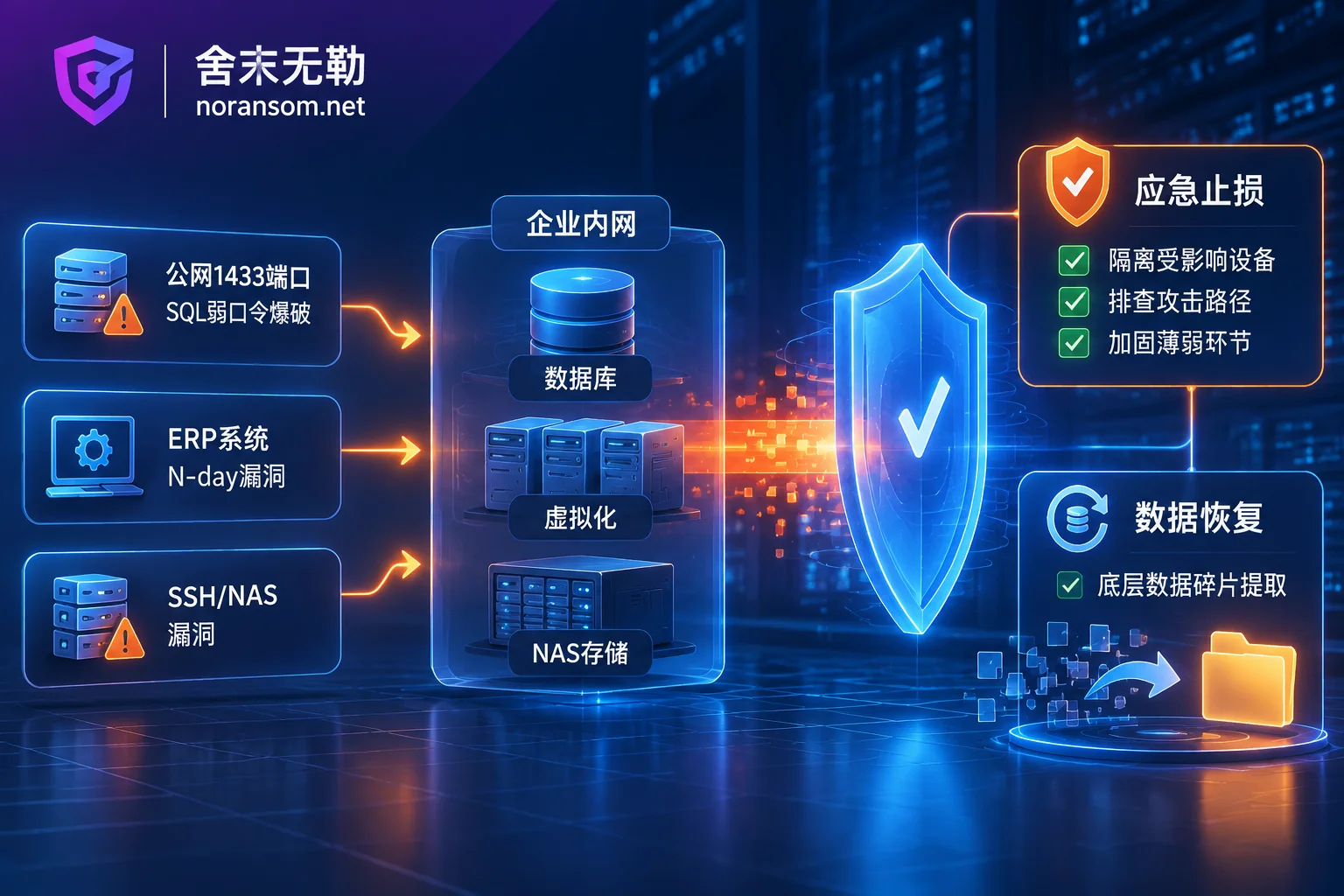
At the moment of encryption, Mallox also exhibits high adversarial capabilities: it uses vulnerable drivers with legitimate signatures (BYOVD) to directly enter the system kernel and forcibly kill security software, uses command-line scripts to batch forcibly stop dozens of database and business services such as SQL Server, Oracle, MySQL to release file occupation locks, and conveniently clears Windows Volume Shadow Copies (VSS), completely cutting off the system's self-healing retreat.
III. After Mallox Encryption, How Can Enterprises Scientifically Break the Deadlock and Rescue Data?
Facing dark web links and high cryptocurrency ransom demands left by hackers, enterprises often fall into anxiety. But as Shemowule has always insisted: do not pay ransom, do not negotiate on behalf of victims. Compromising with hackers not only carries financial risks of not receiving a valid decryptor after payment and being double-extorted, but also touches the red line of corporate compliance.
Scientific self-rescue should follow an engineering path of "stop loss and isolate first, then identify and assess, then layered recovery":
Step 1: Physical Network Disconnection and Scene Protection (Golden 1 Hour)
After discovering anomalies, immediately unplug the network cables of infected servers and associated storage, or block internal lateral communication ports (such as 445, 3389, 1433, 22) through firewalls.
Remember the "Three Don'ts":
- Do not immediately restart the server (some Mallox variants modify registry power options after encryption, and critical attack traces or residual data may remain in memory);
- Do not use antivirus software to forcefully clean the entire encrypted business drive, to avoid destroying samples and environment mapping;
- Do not directly perform file attachment, system reinstallation, or formatting on the original drive.
If you need to quickly control internal spread and completely remove persistent backdoors lurking in the system, it is recommended to immediately launch professional security emergency response services to avoid the tragedy of "recovering data while encountering secondary encryption."
Step 2: Family Variant Identification and Recoverability Assessment
Mallox encrypted files generated in different periods and configurations have completely different underlying damage levels. When ransomware decryption services intervene, engineers first extract ransom notes and a small number of damaged samples for reverse engineering and structural analysis, determine whether the variant has an algorithm-level breakthrough, and issue a detailed recoverability assessment report (covering recoverable scope, optional technical paths, expected completeness, and potential risks).
Step 3: Underlying Data Recovery for High-Value Business Scenarios
When facing the latest high-strength variants without public free decryption tools, "direct key decryption" is not the only way out. Because large commercial files have rigorous underlying page structures and transaction log mechanisms, professional data recovery services still offer great rescue potential:
- SQL Server Database and ERP Accounting System Rescue: When Mallox encrypts large
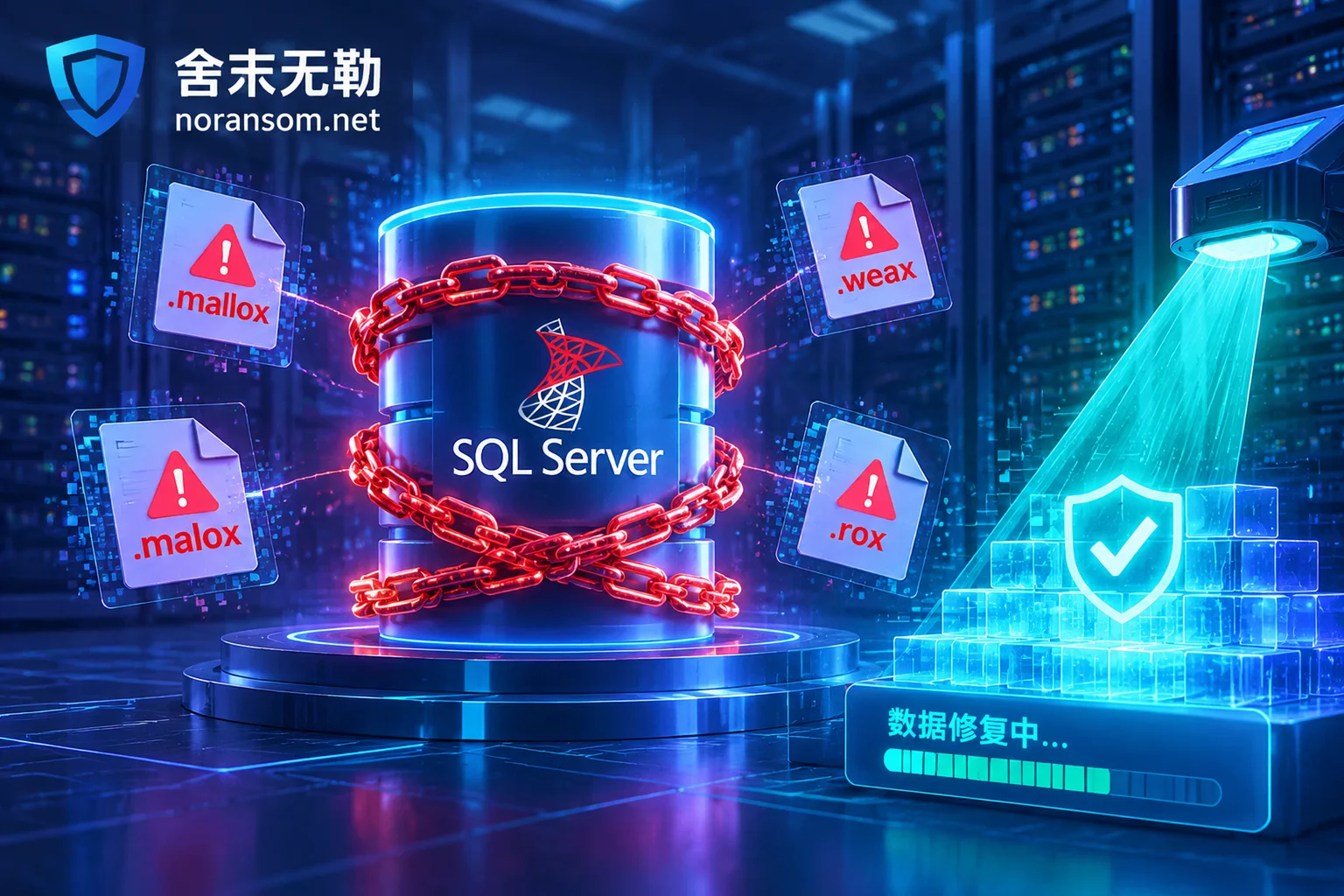
.mdf,.ndffiles, some variants adopt intermittent or specific block encryption strategies to pursue encryption speed. Through underlying page-level parsing, extracting undamaged data page fragments, and reconstructing table structures with residual backups (.bak) or transaction logs, it is possible to effectively rescue core accounting data from Yonyou, Kingdee, Guanjiapo, etc. For such high-incidence pain points, refer to SQL Server Encrypted Recovery Solution and ERP System Encrypted Recovery Solution. - Virtualization and NAS Storage Rescue: If ESXi / Hyper-V virtual disks (
.vmdk/.vhdx) or network storage are compromised, fragment-level extraction and image reconstruction can be performed on virtual disk header descriptors and volume underlying unallocated space. Specific solutions correspond to Virtualization Platform Encrypted Solution, Synology NAS Encrypted Solution, and Backup Deletion or Damage Recovery Solution.
All rescued data will be annotated with completeness by business system and time point and handed to the customer for verification, strictly following a transparent emergency handling and quotation process—the assessment conclusion is delivered to the customer first, and then the customer independently decides whether to proceed with formal recovery.
IV. Mending the Fold: Cutting Off the Attack Loop for Mallox's Return
Successfully rescuing data and bringing business back online is only the first half of the emergency battle. In actual handling, we have found that many enterprises, because they did not find out how the hacker initially entered, merely reinstalled the system or restored the database, only to be locked down again by the same gang within one or two weeks.
To completely eliminate hidden dangers, two finishing tasks must be completed after business recovery:
- Reconstruct the intrusion timeline: Through attack tracing and forensics services, extract system logs, web access logs, and memory images to find out whether the attacker entered the internal network through 1433 weak passwords, 3389 brute force, or an ERP vulnerability, and simultaneously assess whether there is a risk of core data being stolen and leaked (double extortion), and issue a professional forensic report usable for compliance reporting or reporting to public security organs.
- Close exposure surfaces and rebuild backups: Combined with security hardening and protection services, completely close unnecessary high-risk ports such as 1433, 3389, 22 on the public internet (switch to VPN or zero-trust gateway access), disable or harden database
saaccounts, contact ERP software original manufacturers or agents to apply the latest security patches, and establish a truly physically isolated or tamper-proof offsite offline backup system.
If your enterprise servers, databases, or NAS are currently under attack by Mallox (.mallox / .malox) or Weaxor (.weax / .rox / .wxx) and other ransomware, please stay calm and protect the affected scene. You can visit Contact Us at any time, or call Shemowule's 24-hour emergency response hotline 15639272850 (email: help@noransom.net) to obtain targeted family assessment and data rescue support.


Comments(0)